The high-shear rotor/stator mixer (HSM), when relegated to a reasonably narrow niche of mixing applications, has grow to be a mainstay in lots of applications in the chemical method industries (CPI). The ability to apply intense shear and shorten mixing cycles provides these mixers broad appeal for applications that demand immiscible fluids to be formulated into emulsions, or agglomerated powders to be dispersed into a liquid medium. In particular through the final decade, the emergence of new variations on the original rotor/stator mixer idea has extended the HSM’s usefulness to far more diverse applications. For instance, standard HSMs in both major-entering batch configurations and inline versions, are broadly used now for high-intensity mixing, dispersion, disintegration, emulsification and homogenization.
Applications range from dispersions involving gums, pigments, fumed silica, calcium carbonate and active drugs, to emulsions such as cosmetic creams, lotions, and flavors. Even so, in spite of the increasing recognition of HSMs in a lot of industries, they are still broadly misunderstood. Industry-primarily based and university researchers have focused mostly on operating out the dynamics of standard low-shear mixing technologies, such as axialand radial-flow turbines. With only a handful of notable exceptions, higher-shear mixing has been largely overlooked in terms of basic study to unlock its mysteries and support customers to much better predict mixing outcomes, especially in the course of scale-up.
Considering that the body of literature readily available for predictive engineering associated to rotor/stator mixing is very thin, the application of HSMs is generally approached empirically – with heavy emphasis on application-certain testing and improvement by individual manufacturers in the method industries. A handful of users have invested heavily and achieved impressive achievement with HSMs in narrowly defined applications such as ones involving emulsion polymers and pigment dispersions. Other individuals have been significantly less prosperous on their personal. Most potential users of HSMs rely on the recommendation of mixer producers, who typically keep their proprietary application suggestions a closely guarded secret. The result of this lack of readily available understanding about higher-shear mixing is that misconceptions concerning the right application and use of HSMs have proliferated. There are quite ラボ用ミキサー held misconceptions and commonly made application errors. Readers who are capable to keep away from these errors will save time and revenue in their search for the greatest rotor/stator mixer, and lower their risk of picking out a mixing method configuration that appears fine in the laboratory but fails to carry out adequately on the plant floor.
Scaling up
In practically any application, scale up is a vital course of action that impacts your organization in a multitude of techniques, from proper planning of plant floor design and style and equipment configuration, to operating procedures, to the net operating and capital-expense effect on the bottom line. In laboratory-scale trials, misjudging the time expected to accomplish mixing equilibrium by just a handful of seconds can ultimately price your corporation millions of dollars, not to mention wasted time and effort and increased wear-and-tear on the gear, through industrial-scale production.
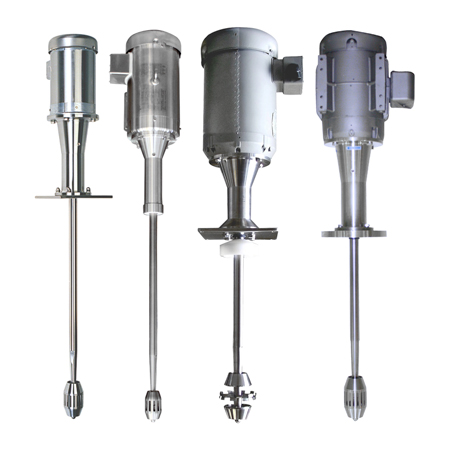
The laboratory tabletop HSM usually represents the 1st step in exploring the distinct benefits of rotor/stator technologies for a provided application. This familiar laboratory tool is commonly equipped with a variety of interchangeable attachments that permit it to operate in a selection of mixing modes – as a standard HSM, as a propeller mixer, and as a high speed “saw tooth” disperser. Such versatility is important in bench-scale improvement, for the reason that it makes it possible for the investigation-and-improvement individual to immediately test quite a few diverse processing approaches.
Nevertheless, as beneficial as the lab scale mixer may be, it is also the supply of 1 of the most widespread and costly mistakes in the scale up from laboratory- scale HSM to pilotscale and production machines. Unless laboratory testing is performed systematically and with good care and accuracy, subtle errors in more than-processing on the benchtop can create huge errors in scale up projections. Such errors are especially typical, for the reason that a lot of engineers underestimate the lab-scale mixer’s extraordinarily higher throughput- to-solution-volume ratio.
Before we move additional, let’s discover one extra idea: equilibrium mixing outcomes. For sensible purposes, this is the point at which the mixed item has acquired a target characteristic – such as a specific droplet or particle-size distribution – that will not change drastically, no matter how extended you continue to approach the solution. When we work with dispersions, this is the point at which we attain the equilibrium particle size. For emulsions, it’s the equilibrium droplet size.
Whether we are working with emulsions or dispersions, this much is particular: we will attain equilibrium a lot quicker with a labscale mixers than with a scaled-up pilot or production unit.
Depending upon the application and the rotor/stator style we use, we may possibly attain this mark in one tank turnover or in numerous hundred-tank turnovers.
Now, take into consideration this common genuine-planet situation involving a test with a lab scale mixer. Take a two-liter beaker and add the following components to prepare an emulsion: Water phase
– Oil phase
– Water- or oil-miscible surfactant
Now, reduce the batch-variety lab HSM into the liquid. But ahead of you push the start button and head down the hall for one more cup of coffee, consider this: That tiny 1-3/8-in. rotor/stator generator on your mixer may perhaps operate with a throughput of 100 liters per minute or far more. With a 2-liter batch in the beaker, that translates to 1 comprehensive batch turnover just about every 1.2 seconds. Presuming that in this application ten tank-turnovers make the preferred emulsion (a plausible number for lots of simple emulsions), this indicates that you may possibly attain mixing equilibrium in just 12. seconds!
In the actual planet, this is where human nature requires more than. As you go for coffee, you maintain the tabletop batch going for 5 minutes, and when you check the benefits you come across that the droplet size distribution of your emulsion is right where you want it to be. A results! But what truly occurred? You processed the batch for five minutes, turned the batch more than 250 instances, and reached the ideal endpoint. But your solution did not change after it had reached its mixing equilibrium in just 12 seconds – so the remaining 4 minutes and 48 seconds produced no appreciable alter in the mixed solution. That’s the margin by which you in fact overshot your mixing equilibrium. In a lab-scale example, over processing by 4 minutes and 48 seconds might not look like a huge deal – but take into consideration the implications in terms of productivity, energy fees, labor, and put on and tear when such an error is propagated for the duration of scale up to a bigger pilot- or production-scale unit.
Now, rapid-forward to your scale up requirements utilizing the above example. Think about that you will require to generate this item in 500-gallon batches. If you assume that you will will need 250 tank turnovers to accomplish your approach objectives (instead of 10, which is definitely all you need to have), then you will choose a top-getting into, batch HSM that will process 125,000 gallons through its rotor/stator generator in an acceptable period of time. Drawing from expertise, we assume that a 30-hp unit with a 7-in.-dia. rotor will pump roughly 500 gal/ min. Hence, our 250 tank turnovers (125,000 gallons) will call for 250 minutes (four hours, 10 minutes). This projects to a capacity of roughly two batches per eight-hour shift, or 10 per single-shift week. If, at the lab scale, we had superior understood that the process target was reached in just 12 seconds (10 turnovers), we could have projected that the similar production unit would full the process in about ten minutes. This projects to roughly 240 batches per week – an boost of 230 batches per week.
About the Author